
Laptop-grade speed and big runtime — great for travel, but not pocket-friendly and one cable is a single point of failure.
Nothing kills your day faster than a dead battery when you’re away from a plug. If you rely on a phone, tablet or even a laptop while traveling or working remotely, you need a charger that can deliver multiple fast charges without turning into a tangle of cables and waiting around.
The Anker Power Bank, 20,000mAh with an 87W max output and a built-in USB‑C cable aims to solve that exact problem: laptop-level speed, a large capacity for several full charges, and multiple ports so you can juice more than one device. Just be aware you’ll trade off some pocketability and accept the risk of a non-replaceable integrated cable if it gets damaged.
Anker 20,000mAh 87W Power Bank (USB-C)

You get a rare combination of laptop-level power and mobile convenience — ideal when you need multiple fast charges on the go. Expect excellent speed and runtime, though you’ll trade off some pocketability and risk a non-replaceable built-in cable.
Overview
You’re looking at a portable battery designed to bridge the gap between phone chargers and laptop chargers. This Anker power bank offers 20,000mAh of capacity and up to 87W combined output, with one integrated USB-C cable that tucks neatly into the chassis. It’s built for people who carry multiple devices — phones, tablets, and occasionally a laptop — and who want fast, reliable charging away from the wall.

What you get in practical terms
The headline specs are clear: a 20,000mAh Li-ion pack, up to 87W total output, and a built-in, heavy-duty USB-C cable rated for thousands of bends. What that means for you day-to-day is straightforward: you can top up a modern smartphone multiple times, give a tablet a full charge, or provide meaningful runtime to a thin laptop or 14″ MacBook Pro while traveling.
Design and build: convenience with trade-offs
Anker keeps the design practical rather than flashy. The matte black finish resists fingerprints, the built-in cable stores flush in a side channel, and the small digital display gives you an exact percentage instead of vague LEDs. That built-in cable is the biggest UX win: you won’t scramble to find a cable when your phone hits 5%.
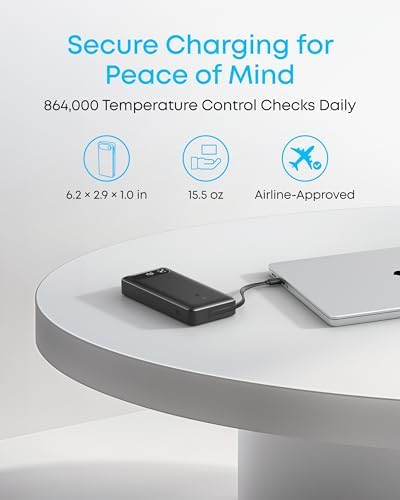
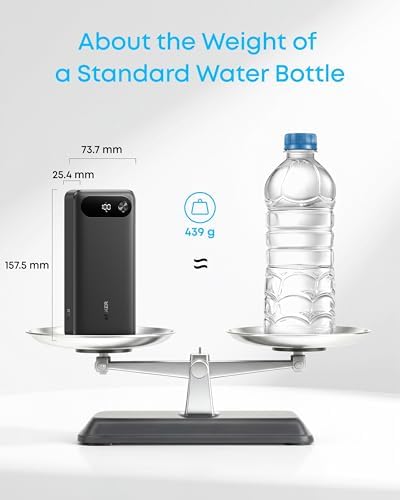
However, to house a 20,000mAh pack and a robust cable, the unit carries weight (around ~431 g) and a footprint larger than compact power banks. If you normally carry just a slim wallet and a phone, this will feel substantial; if you tote a backpack or camera bag, it’s no problem.
Charging performance: what to expect
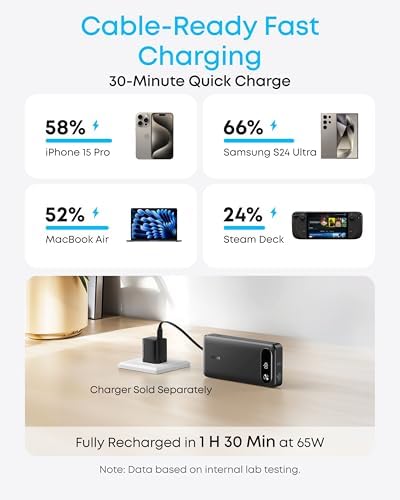
This is where the power bank shines. With a capable PD wall charger to recharge the bank and a device that supports high-wattage USB-C PD, you’ll notice laptop-grade charging speeds. For phones and tablets that support USB-C PD, you can expect much faster top-ups than older 18–30W chargers. When you need to share power between devices, the pack intelligently allocates up to 87W across three ports, with a single device able to draw up to 65W.
Real-world examples you can expect:


Portability, travel, and airline rules
Because the battery sits at 20,000mAh, it typically meets the airline allowance for carry-on power banks (always check your airline’s specific rules). That makes it a very practical travel companion when you need to avoid dead devices during long flights or layovers. You’ll, however, feel the weight if you plan on carrying it in a light jacket pocket — consider storing it in a backpack or day bag.
Battery life and real-world runtime
20,000mAh translates into multiple full phone charges and at least one full tablet or significant laptop top-up depending on device efficiency. Expect between 2–4 full smartphone charges for most modern phones; heavier-power devices like laptops will get partial—but rapid—refills. Remember that conversion losses and device draw affect usable output.
| Item | Typical Result |
|---|---|
| Modern smartphone (6–8 Wh battery) | ~2–4 full charges |
| Tablet | ~1–2 partial/full charges |
| 14″ laptop | ~40–60% boost depending on model and load |
How to get the most from it
You’ll prolong the life and usefulness of the pack by pairing it with a high-quality 65W USB-C PD charger for recharging the bank, keeping it in a cool place while charging heavy loads, and occasionally running full discharge cycles to calibrate the display.
What to watch out for
The built-in cable is highly convenient, but it does create a single point of failure: if that cable is damaged, you still have other ports, but you lose the “grab-and-go” convenience. Additionally, while 87W total output is generous, charging multiple high-wattage devices simultaneously will split power and reduce peak per-device speeds.
Final thoughts
If your life involves travel, remote work, or power-hungry mobile devices, this Anker 20,000mAh pack gives you laptop-level power in a single portable unit. You’ll enjoy fast recharges, multiple output options, and the instinctive convenience of an integrated cable. If you prioritize ultralight carry, consider a smaller-capacity alternative, but if you want powerful, reliable on-the-go charging, this is a very practical pick.
FAQ
Yes — at 20,000mAh this power bank typically fits within airline carry-on limits, so you can bring it in your hand luggage. Always confirm with your airline’s specific battery rules and keep the bank in your carry-on rather than checked baggage.
It can — the pack supports high-wattage USB-C PD and can deliver up to 65W to a single device, which is enough for many thin laptops. Performance depends on the laptop’s PD negotiation and whether you use the built-in cable or the additional USB-C port; either will give fast charging for compatible machines.
The integrated cable isn’t designed to be user-replaced, so a physical failure would remove that convenience. You can still charge devices using the other USB-C or USB-A ports, so the bank remains functional even without the built-in cable.
With a 65W USB-C PD wall charger, you can recharge the power bank in roughly 1.5 hours from empty. Lower-wattage chargers will take longer; for the fastest turnaround use a 65W PD-capable adapter.
No — modern phones negotiate charging rates via USB Power Delivery and other protocols. The power bank will deliver the maximum safe speed the phone accepts. If you prefer gentler charging, some phones let you toggle slower modes, or you can use a lower-power USB-A cable.
To maximize usable charges, charge devices with the most efficient curves first, avoid charging while devices are under heavy load (like gaming), keep the bank cool, and use the bank’s USB-C PD port for better efficiency. The digital display helps you track remaining capacity so you can plan top-ups.
Yes — it’s a popular choice for handheld gaming devices because of the high output and large capacity. Your runtime gain will depend on the device’s power draw; heavy gaming will still consume power quickly, but the bank will extend playtime considerably compared with the internal battery alone.
The digital percentage display provides a precise, instantaneous reading that’s more informative than the traditional LED dot indicators. It’s useful for planning multiple charges and avoiding mid-trip surprises.