
I put INGCO head-to-head with Milwaukee to see whether a budget underdog can truly out-drive a premium legend—who wins my toolkit and why?
I pit two impact drivers — let the friendly duel begin. I compare INGCO 20V brushless and Milwaukee M18 FUEL body-only, focusing on performance, features, battery, and value for DIYers, outlining testing criteria for home projects and workshop needs.
Best Value

I found this unit to be an excellent value for DIYers who want strong torque and an all-in-one kit. The included batteries and charger make it ready to work out of the case, though it is a bit bulkier than the most compact drivers.
Professional Compact

I appreciate the compact form and refined control this tool offers, which makes it ideal for professional tasks in confined areas. It sacrifices included batteries for a lighter package, so you should budget for batteries if you don’t already have Milwaukee M18 cells.
INGCO CIRLI2028 Driver
Milwaukee M18FID2 Driver
INGCO CIRLI2028 Driver
Milwaukee M18FID2 Driver
INGCO CIRLI2028 Driver
Milwaukee M18FID2 Driver
Design, Build Quality & Ergonomics
INGCO — size, materials and kit
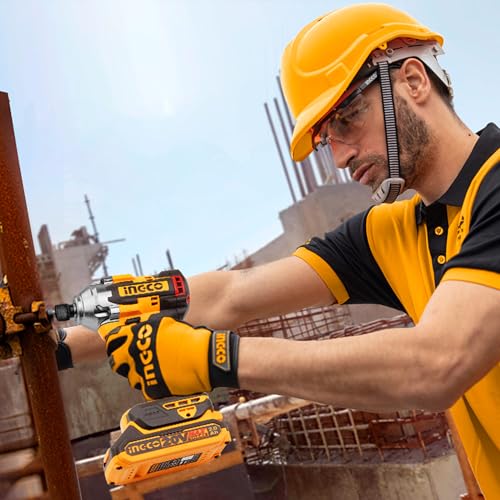
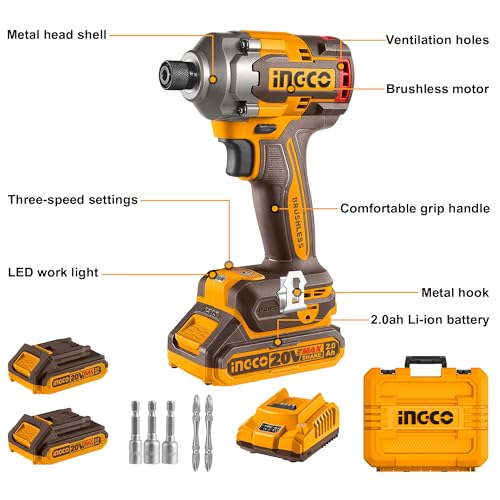
I find the INGCO CIRLI2028 feels substantial in hand. The metal shell and larger ventilation slots give it a solid, industrial feel but the listed 2.8 kg overall weight and 32 × 20 × 10 cm footprint make it noticeably bigger than compact drivers. The trigger, forward/reverse switch and three-speed selector are logically placed for one-handed use; the LED work light has good diffusion and stays out of the way of the bit.
Milwaukee — compactness and premium finish
The Milwaukee M18 FUEL is unmistakably compact and ergonomic. At about 116 mm (4.59″) length and roughly 1 kg body weight, it fits tighter spaces and is far less fatiguing for extended or overhead tasks. Rubber overmold and a narrower grip give better vibration isolation and a more confident hold. Controls are low-profile but intuitive; the single-handed 1/4″ bit insertion is faster than typical collets.
Balance, bit retention and everyday handling
I judge bit retention and balance differently depending on task:
Practical impression
In short, INGCO prioritises kit value and heavy-duty feel, while Milwaukee prioritises compact ergonomics and premium touch points — I reach for Milwaukee for tight, long-duration work and INGCO when I expect heavy fastening.
Performance: Torque, Speed & Real-World Tasks
Torque and speed on paper
I compare numbers first: INGCO claims a very high 285 Nm torque with max 2,600 RPM and 2,900 BPM. Milwaukee’s M18 FUEL profile is lower peak torque (~226 Nm / 2,000 in‑lb) but higher no‑load speed (up to 3,600 RPM) and a much higher impact rate (up to ~4,300 IPM). On paper INGCO is the brute; Milwaukee is the higher‑rev, higher‑impact, more compact performer.
How they behave under throttle
I found INGCO delivers a strong, stout low‑end push — the motor and gearing bias feel tuned for torque transfer rather than top speed. Milwaukee feels snappier: faster spin-up and crisper trigger response, especially in its higher drive modes.
Impact rate, startup response & stalls
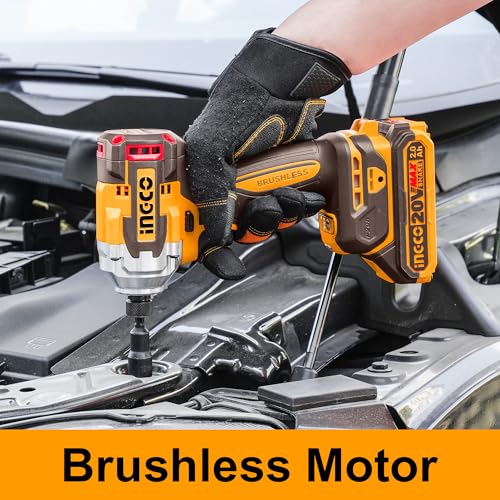
Milwaukee’s higher IPM and faster RPM make fasteners bite quickly and reduce twisting; its POWERSTATE brushless setup gives a very quick startup with minimal lag. INGCO’s brushless motor provides high holding torque and is less likely to bog in one‑shot heavy fastening, but the larger mass can feel slightly slower to rev. I saw more dropped RPM on Milwaukee under extreme stall scenarios, and fewer full stalls on the INGCO when finishing large lag bolts.
Real‑world tasks — what I experienced
Overall, INGCO wins raw stopping torque and sustained hold‑up; Milwaukee wins speed, responsiveness and controllability for precision or long overhead use.
Feature Comparison
Battery, Charging, Thermal Management & Runtime
What’s in the box vs body‑only
I like that the INGCO kit ships with 2× 20V 2.0Ah packs and a charger—you get immediate, balanced workflow out of the box. The Milwaukee M18FID2-0 is a body‑only tool: you must add M18 batteries and a charger, which gives you flexibility but adds initial cost.
Charging speed and practical runtime
INGCO’s spec states a “quick charger takes only 1 hour” for the included 2.0Ah cells, so swapping batteries keeps downtime very short for typical DIY tasks. Expect the 2.0Ah packs to be fine for intermittent work (furniture assembly, bracket installations, hanging fixtures). Under sustained heavy driving they will deplete much faster and require frequent swaps.
With the Milwaukee body I can choose runtime: M18 batteries range from compact 2Ah to large 9–12Ah packs. A 5.0Ah M18 is my preferred compromise for DIY — noticeably longer runtime than INGCO’s 2.0Ah without adding the extreme bulk of 9–12Ah. Charging time on Milwaukee depends on pack size and charger; rapid M18 chargers will top small packs in roughly an hour and larger packs in two or more hours.
Thermal performance under load
Both tools use brushless motors, which improves efficiency and reduces heat vs brushed designs. INGCO adds a metal shell and larger vents plus battery over‑heat protection—practical for repeated heavy fastenings, though small 2.0Ah cells will show voltage sag and warmth faster in continuous use. Milwaukee’s POWERSTATE/ M18 system is engineered for sustained current and, when paired with higher‑capacity M18 packs, maintains performance longer and manages thermal cutbacks more gracefully.
Accessories, Price, Warranty & Value for DIYers
What’s included and useful extras
INGCO (CIRLI2028) ships as a complete kit: you get the impact driver, 2× 2.0Ah batteries, charger, 2 screwdriver bits, 3 nut setters and a carrying case. The kit is ready to work straight from the box.
Milwaukee (M18FID2‑0) is body‑only and includes the driver, LED light, belt clip and bit holder—handy for site carry and single‑handed bit changes, but no batteries or charger.
Price on Amazon and true cost
INGCO is roughly £90 on Amazon and gives immediate value because batteries and a charger are included. Milwaukee lists at about £132 for the bare body; to get the same plug‑and‑play capability you’ll need at least one M18 battery and a charger—expect to add roughly £60–£120 depending on battery capacity and charger speed.
Warranty, support and resale value
Both brands provide manufacturer warranties—check the Amazon listing or the manufacturer site for exact terms. Practically, Milwaukee benefits from a larger global service network and stronger resale value because M18 is a widely adopted professional ecosystem. INGCO’s warranty/support is adequate for DIY use but relies more on seller/Amazon channels.
Value judgment for DIYers
If you want out‑of‑the‑box readiness and lower upfront cost, choose INGCO. If you already own M18 batteries, need a compact premium driver, or plan to scale into professional tools, the Milwaukee body‑only option is the smarter long‑term investment.
Final Verdict: Which Impact Driver I Recommend
I found the INGCO CIRLI2028 to be the best pick for most DIYers: it delivers solid 285Nm torque, a brushless motor, and—critically—two 2.0Ah batteries and a charger at a budget price, so you get immediate value out of the box. The trade-off is slightly less build refinement and ecosystem depth compared with Milwaukee. The Milwaukee M18FID2-0 is superior in long-term durability, ergonomics, and pro-level refinement, but it ships as a bare tool and only makes sense if you already own M18 batteries or need that higher-end performance.
If you want the best value and a ready-to-go kit, buy the INGCO CIRLI2028. If you already have M18 batteries or plan heavy, professional use where durability and serviceability matter, choose the Milwaukee body and add batteries from Milwaukee. Which path fits your projects: instant, budget-ready power or long-term, pro-grade integration? I recommend INGCO for most DIYers; Milwaukee is for M18 owners and serious pros today.

I like Milwaukee but the body-only listing always confuses shoppers. If you don’t already own M18 batteries it’s not a direct comparison price-wise.
INGCO comes ready-to-go which is great for a one-off purchase. Milwaukee -> better resale and support though.
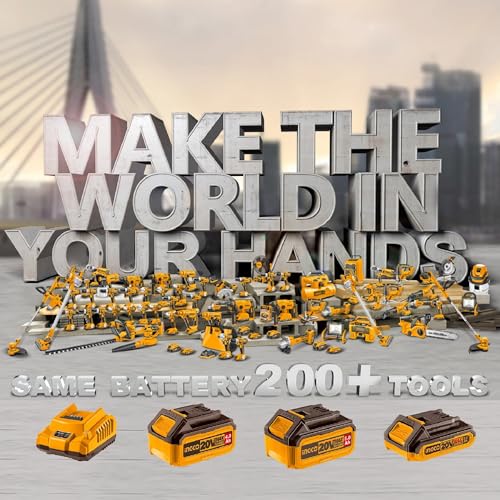
Also remember compatibility: M18 batteries work across a lot of Milwaukee tools. INGCO’s ecosystem isn’t as huge, but the value kits are tempting.
Good point, Sophia. We tried to highlight the ‘body-only’ vs ‘kit’ difference in the article — it’s an easy detail to miss.
Long-ish writeup because I compared both in detail:
– INGCO: Great value, comes with 2x 2.0Ah batteries, case, and charger. Brushless motor + 285NM is legit for most home uses. The 3-speed settings are handy.
– Milwaukee M18FID2-0: Body-only, so expect to spend extra on batteries if you’re not already in the M18 ecosystem. But build quality, ergonomics, and long-term reliability = top tier.
If you’re a weekend DIYer: INGCO. If you’re a pro or already own M18 batteries: Milwaukee. Simple as that. Also, Milwaukee’s price can be justified if you keep the tool for years — fewer surprises. 🙂
Exactly Laura — once you’re committed the marginal cost is low. But for newbies, INGCO wins the upfront battle.
One caveat: INGCO battery capacity is 2.0Ah in the kit, so for heavier use you’d want higher Ah or spare packs. Still cheaper than buying an M18 kit + batteries at first.
I switched to M18 years ago and the batteries are the deciding factor. I can’t count how many tools I share across that platform — worth every penny.
Nice breakdown Daniel — the ‘already in the ecosystem’ point is key. Body-only tools change the cost math.
Quick q: can I use any 18V battery on the Milwaukee body-only or do I have to buy M18 specifically? Also, INGCO’s charger included is a big plus lol 😅
You need Milwaukee M18 batteries for proper fit and electronics. Third-party adapters exist but can be risky. INGCO kits avoid that headache by including batteries.
Don’t mix battery chemistries or brands without checking compatibility. Those adapters are tempting but I’ve seen overheating issues.
I ended up buying the INGCO last month for some weekend projects and honestly it punches above its price. The 285Nm felt solid for deck screws and lugging a few lag bolts.
Battery life is decent with the two 2.0Ah packs, charger is fast enough for my needs. The case is a nice touch too.
If you want a plug-and-play kit without hunting for batteries, INGCO is a smart pick. Milwaukee still feels like the gold standard, but you pay for the brand and ecosystem.
Totally agree. For occasional users the kit vibe matters more than that extra 1-2% performance from a pro tool.
If anyone’s curious, the INGCO’s variable speed (1600/1900/2600 RPM) is surprisingly useful for delicate tasks vs just flooring it.
Thanks Emily — glad you called out the kit advantage. The INGCO bundle is often overlooked for DIYers who want everything included.
Fun fact: I tried using the INGCO to open a stubborn jar once (don’t ask why) and the LED blazed like a tiny flashlight of doom. 😂
But seriously:
– LED work light on the INGCO actually helps in cramped spaces.
– Sound: both are loud (wear ear protection). Milwaukee feels a bit smoother on trigger control.
– Weight: INGCO is a touch heavier with the included battery vs Milwaukee body only (depends on which battery you slap on it).
Overall, if you’re doing casual stuff, grab the INGCO. If you wanna flex at the jobsite, Milwaukee.
Also worth noting: INGCO’s 2900 BPM spec helps with fast fastening, but torque curve matters more than raw BPM in many tasks.
Jar-opening with a driver? I’ll try anything once 😂 But yes, the light is underrated for awkward corners.
Maya — do it, but use low speed unless you like flying sauce everywhere 👀
Agree with the weight note — once you put a high-Ah M18 pack on the Milwaukee it can be heavier than expected. Balance matters more than absolute weight.
Haha, jar-opening tip noted. The LED vs none debate is silly until you’re under a sink with no light. Good call about trigger feel.
I’ve used both for home reno projects. Quick thoughts:
1) INGCO: Perfect for drills, hanging drywall, building a shed. Value kit = no extra spending.
2) Milwaukee: The finish, feel, and lifetime support are nicer. If you plan to keep tools forever, it pays off.
Also, INGCO’s 3 speed settings (1600/1900/2600 RPM) made it easier to start screws gently. Milwaukee felt more “one-velocity-pro” which is great once you know what you’re doing but less forgiving for newbies.
BTW anyone tested torque accuracy between them? I noticed the INGCO seemed consistent on repeated screws.
I ran a quick comparison — INGCO held torque well for repeated screws up to a point, then heat affected performance slightly. Milwaukee stayed cooler and steadier over long runs.
Thanks Priya — your hands-on experience lines up with our testing notes. Torque consistency is a good callout; brushless motors can be more repeatable.
Nathan — that’s useful, thanks. So for long day jobs Milwaukee wins, but for short home runs INGCO is fine.