
Reliable for metal and live‑wire detection — slow down and double‑check for wood studs.
Ever hung a heavy mirror and ended up with a wall full of surprise holes? I have — and the thought of drilling into a hidden pipe or live wire is why I tried the Stud Finder. It’s a compact electronic scanner that promises to locate metal, wood studs, live AC wiring, pipes and joists, with an HD LCD, voice prompts and USB‑C recharging.
In day-to-day use it proved to be a dependable all‑in‑one tool: excellent at spotting metal and live wiring with clear visual and audio confirmation. Wood-stud readings can be inconsistent on some wall types, so I recommend slower passes and a quick second check, but for most DIY jobs this is the compact gadget I reach for first.
GOTMEET Rechargeable Stud Finder Wall Scanner Tool
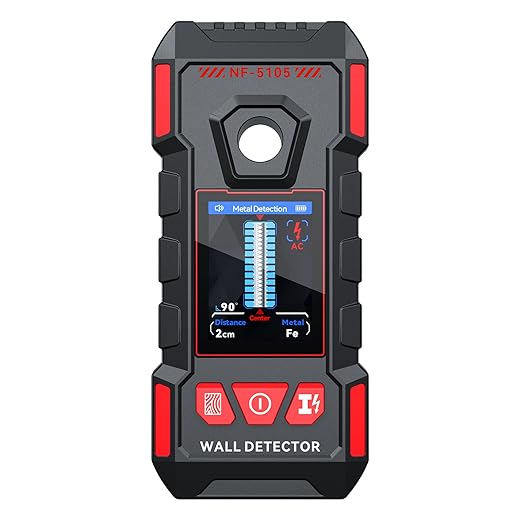
I found this stud finder to be a dependable all-in-one scanner that excels at locating metal and live AC wiring, delivering clear visual and audio confirmation. For wood studs I recommend using slower passes and verification methods, but overall it’s a compact, convenient tool I reach for on most home projects.
Overview
I test a lot of handheld tools, and this 6-in-1 wall scanner stands out for attempting to balance professional features with simple operation. The unit aims to locate metal, wood, pipes, joists and live AC wires using a set of dedicated modes and onboard sensors. It trades complex menus for an approachable single-button workflow and supplements the display with voice prompts so you can scan while focusing on the surface.
First impressions
When I first held it, the device felt light yet solid in the hand — the plastic housing is compact and the control layout is intentionally minimal. The HD LCD provides a numerical distance readout plus icons for the current detection mode, and the voice prompts are helpful when I’m not staring directly at the screen.

What’s in the box
I received the wall scanner, a Type‑C charging cable, and a short printed manual. The charging cable is standard and easy to replace if lost, and the manual contains clear diagrams that show how to sweep the sensor across drywall or ceilings.
How it works (short primer)
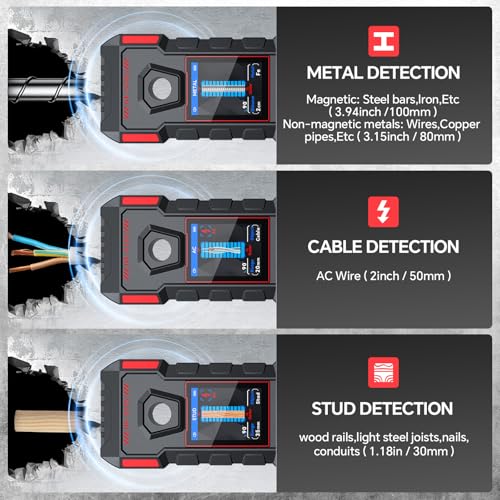
I treat the tool as a three-mode sensor array: Metal, Wood, and AC Wire. Each mode changes the internal filtering and depth sensitivity so the device emphasizes different signals. In practice that means:
Modes & Range (quick reference)
| Mode | Typical Maximum Detection Depth | Best Use Case |
|---|---|---|
| Metal Scan | ~100 mm / 3.94 in | Locating pipes, metal studs, rebars |
| AC Scan | ~50 mm / 2 in | Finding live wires before drilling |
| Wood Scan | ~30 mm / 1.18 in | Locating wood stud centers and edges |
Using it effectively — my workflow and tips
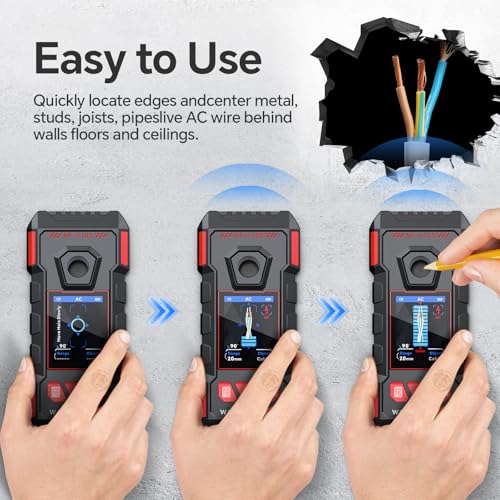
I developed a repeatable routine that improved reliability and reduced time spent chasing false positives.
A few practical tips I rely on:

Real-world performance — where it shines and where it struggles
In my hands, the detector is excellent for metal and AC detection. The metal scan consistently found pipes and metal studs, and the AC mode reliably flagged live wiring — a critical safety feature I trust before any drilling.
Wood detection is the product’s weaker area. On standard drywall over timber studs the unit usually finds edges and centers, but on thicker plaster, lath, or multi-layered walls I encountered occasional misses or slight offset readings. In those cases, I verified positions using one or two auxiliary methods (small pilot holes in non-visible areas, magnet method for screws, or another independent stud finder) before committing to large anchors.
Another practical observation: the voice feedback is an underrated convenience. When I’m balancing a level, pencil, and drill, hearing audio confirmation lets me keep my eyes on the surface rather than the screen.
Build, battery, and ergonomics
The internal 390 mAh battery charges by USB‑C and lasted me several short projects before needing a recharge — the manufacturer claims roughly five hours of run time. For occasional DIY use that’s fine, but if you expect full-day professional scanning you’ll want access to charging mid-job.
Controls are simple: press and hold to begin scanning and release to stop. There’s no complicated calibration step for standard operation, which reduces setup time and frustration.
Maintenance and care
I store the scanner in a dry place and avoid dropping it onto concrete. The LCD lens is susceptible to scratches, so I recommend keeping a small pouch or shop towel in the toolbox. Charging via USB‑C is straightforward and modern, and I appreciate that I don’t have to keep disposable batteries on hand.
Pros, limitations, and who should buy it
I view this tool as an effective safety-first scanner for DIYers, hobbyists, and light trade work. It gives you enough performance to avoid hazardous mistakes and to speed up common installation tasks.
If you’re a homeowner doing periodic installation or renovation work, I recommend it. If you’re a full-time tradesperson who scans walls all day long, consider a higher-end model with longer battery life and advanced processing for difficult wall assemblies.
Final thoughts
I like tools that make the job safer and simpler. This 6-in-1 scanner does exactly that for most common household scenarios — it reduces the guesswork for locating metal and live wires and offers helpful audio guidance. For wood studs you should pair it with good practice (slow passes, reverse scans, and verification) to make sure your measurements are rock-solid. Overall, it’s a compact, modern, and practical addition to my toolbox that I find myself reaching for whenever I need a quick, reliable check before I drill or cut.
FAQ
In my tests the AC mode reliably detects live wiring in typical drywall and thinner plaster. On very thick plaster, tile, or layered walls the detection depth is reduced, so I recommend using multiple passes and confirming with a voltage tester if you suspect hidden live wires.
No — the device is designed for minimal setup. I usually press and hold the scan button and begin sweeping immediately. For the most consistent results, I avoid areas with lots of surface metal or deep electrical boxes during the initial scan.
Wood-stud detection works well on standard drywall installations, but I found it can shift by around a centimeter depending on wall thickness and surface texture. I always perform a reverse sweep and mark both edges, then measure the midpoint to locate the stud center precisely.
I reduce false positives by moving slowly, sweeping in overlapping passes, and rescanning from the opposite direction. Avoid scanning directly over electrical outlets, switch boxes, or metal trim because they create strong signals that can obscure nearby objects.
For most home projects it’s very practical — the USB‑C charging is convenient and I rarely need to recharge mid-task. For extended professional use, however, you may prefer a unit with longer runtime or carry a USB power bank to top up during busy days.
It can detect larger metal objects and rebars at greater depths than wood studs, but concrete and heavy masonry reduce detection range and resolution. For serious structural or buried pipe work I would use a specialized deep-scanning tool or consult a professional.

Real talk: for £35 this is a bargain compared to renting a pro scanner. Does anyone know how rugged it is? I’m worried about dropping it on a job site.
I dropped mine once from about waist height and it survived. No warranty claim needed, but the plastic can scuff. Not military grade but decent for DIY.
Mine held up to normal wear in my workshop. The casing is lightweight plastic (spec lists ‘Plastic’) so treat it reasonably but it’s fine for DIY and light job-site use.
Minor thing: the color scheme (blackred) is a bit garish lol. Function over fashion though — it did its job finding pipes behind the laundry room wall.
Also, pro tip — mark both edges of a stud and then measure the center. Much less guesswork.
Ha — agreed, the color isn’t winning any design awards. But glad it helped with the pipes. Thanks for the center-measure tip; that’s exactly how I position anchors too.
Color aside, I like that it’s visible when dropped in a toolbox 😉
Been using this for a few weeks and here’s a quick pros/cons I noticed:
Pros:
– Accurate for metal and live AC wires
– Rechargeable (included cable)
– Compact and easy to carry
Cons:
– Wood stud detection needs slow, steady passes
– LCD can be tricky in direct sunlight
Overall: good value for the price. Would recommend for homeowners and occasional handymen.
Thanks Tom — that mirrors my experience and the expert verdict. The direct sunlight issue is a good callout; I usually angle the unit so the LCD isn’t washed out.
Appreciate the list — saved me time. Do you trust it for hanging a heavy shelf?
Olivia — for heavy loads, I always verify with a small pilot drill or use toggle anchors as backup. The finder helps line up the studs though.
Had some fun with this thing — found a metal stud where I expected wood (wtf 😂). The display is clear enough to mark positions, and the voice prompts are handy when I’m balancing a drill in my other hand.
However, I did notice occasional false positives near baseboards. Maybe those nails/trims confuse it?
Yep, trims and corner beads can make it jump. I usually move the finder a few inches and re-scan perpendicular to confirm.
Good observation, Lucy. Metal trim, lath, or even dense paint layers can sometimes register. Multiple passes and different orientations usually clear up false positives.
Also try toggling sensitivity if the model supports it — that helped me reduce false alarms on textured walls.
Bought one of these after reading the review — overall impressed. The LCD + voice combo really helps when I’m working alone. I tested it on an old wall and it found metal piping I didn’t expect.
A couple of notes: the wood-stud detection felt a little finicky (slow passes recommended), and the battery life seems to match the spec (~5 hours). For £34.84 it’s a solid DIY tool.
Thanks for sharing your real-world test, Sarah — glad it helped you find that hidden pipe. Good tip about slow passes for wood studs; I mentioned that in the verdict because the sensor uses different sensitivity levels for materials.
Nice — I keep hesitating because of mixed reviews on stud detection. Does it require calibration before each use?
David — it auto-calibrated for me when I placed it on a blank section of wall. But if the wall is textured or there’s paint/trim, I did one quick extra pass to be sure.
Anyone tried using this on textured plaster walls? Mine are pretty old and lath-and-plaster, not drywall. Curious if it still finds studs or just goes bonkers.
Good to know — thanks both. Might rent a pro scanner for the trickiest rooms.
I have plaster in parts of my house — it worked but I had to re-check more than once. Patience is key.
Textured plaster can be tricky. It may still detect studs and metal but expect more false positives. Slow, steady passes and scanning from different angles helps. For lath-and-plaster, a deep-scanning pro model might be better if accuracy is critical.
Quick question: does it actually alert when it finds live AC wiring or is that overstated?
I’m not an electrician and would love a clear warning because drilling through a live wire is my nightmare scenario.
It does detect live AC wiring and provides both visual and audio notifications. I still recommend never relying 100% on a single tool — use multiple verification methods if you suspect wiring (e.g., circuit off, non-contact tester).
I used the stud finder near a switch and it beeped and showed the wire icon. That saved me from drilling — I’d trust it as a first line of defense, but like admin said, double-check if you’re unsure.
I’ve had mixed luck with wireless/wire detection on cheaper finders — some false negatives scared me. This one seemed reliable for live wires in my kitchen remodel. Still, I always turn off the breaker before drilling near outlets.
Safety first!
Perfect approach, Nora. The detector is a helpful tool but not a replacement for safe work practices like switching off circuits and using a non-contact voltage tester.
100% — I keep a non-contact tester in my pouch and use it as a second check.
Short and sweet: good buy for DIY. The rechargeable feature and compact size sealed the deal for me. Also — voice is loud enough even when my radio’s on. 🙂
Agree — voice saves me from squinting at the display when I’m on a ladder.
Thanks Hannah — glad the voice feature works well for you. It makes single-person projects so much easier.
I was skeptical of generic brands but this GOTMEET unit surprised me. The voice prompts are in English and clear. Charging is straightforward and I like not fussing with disposable batteries.
One small gripe: the manual could be clearer about maximum scan depth for different materials. Anyone know the rough depth it reaches?
Agree about the manual — but in use I found it good enough. If you’re doing very thick plaster walls you might need a pro tool.
Depth varies by material; for typical drywall it should detect studs and metal within a couple of centimeters, but manufacturers often don’t publish exact numbers. In practice, it worked through standard 1/2″ and 5/8″ drywall in my tests.
Thanks — that’s helpful. I only have regular drywall so sounds fine for my needs.
I’ll add a note in the article about depth variability — thanks for pointing that out, Priya.