
It’s ideal for fine detail and crafts—handy and precise, but not built for heavy lifting.
Imagine they’re hunched over a tiny model or trying to tidy a stubborn grout line, only to be thwarted by a clumsy, noisy tool that’s more sledgehammer than scalpel. It’s frustrating, time-consuming and often leaves delicate work ruined — which is exactly the problem this little gadget aims to fix.
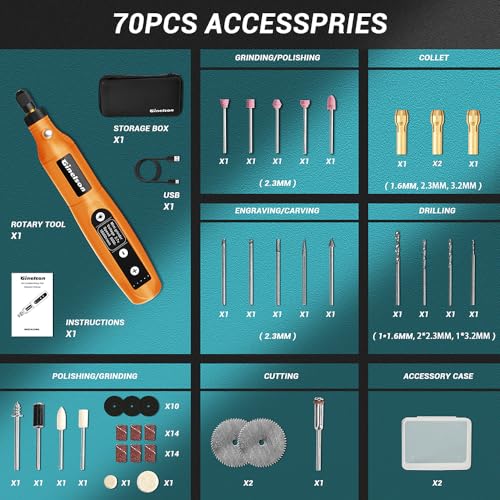
Enter the Mini Cordless Rotary Tool: a compact, USB‑C rechargeable multi-tool with five speed settings, a helpful LED and 70 attachments for sanding, polishing, engraving and more. It shines on close-up, light-duty tasks with low noise and long runtime, though it won’t replace a full‑size drill for heavy jobs and a few accessories feel a bit flimsy.
Mini Cordless 5-Speed Rotary Tool Kit

A handy, lightweight multi-tool designed for intricate work around the house and in craft projects. It gives precise control and long battery life for its size, though it lacks the torque required for demanding jobs.
Overview
The Mini Cordless Rotary Tool is a pocketable multi-purpose rotary that targets hobbyists, crafters, and light home repairs. Built around a 3.7V rechargeable battery and a USB-C charging port, it is intended to bring precision and portability to tasks such as sanding, polishing, drilling small holes, etching, engraving, trimming, and light cutting. The compact form factor makes it easy to position for fine detail work, and the variable speed control helps match tool speed to material and bit type.
Key features at a glance
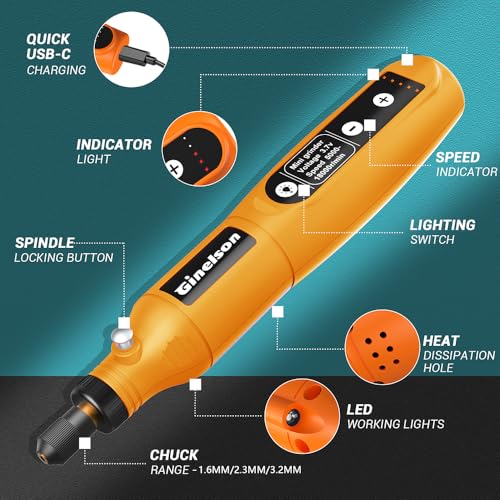
Detailed specifications (quick reference)
| Specification | Detail |
|---|---|
| Voltage | 3.7 V |
| Maximum speed | 18,000 RPM |
| Speed steps | 5 (5000 / 8000 / 11000 / 14000 / 18000) |
| Power source | Rechargeable battery (included) |
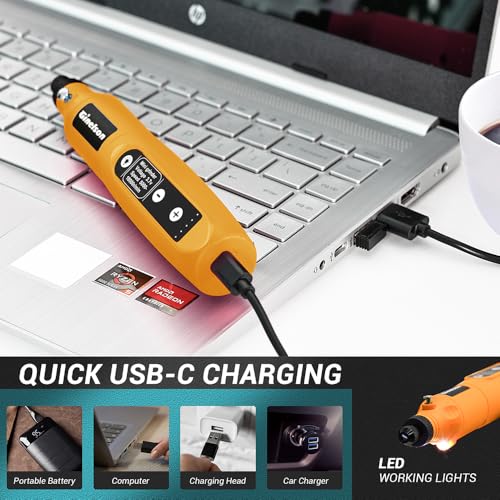
| Charging | USB-C (indicator LED turns green when charged) |
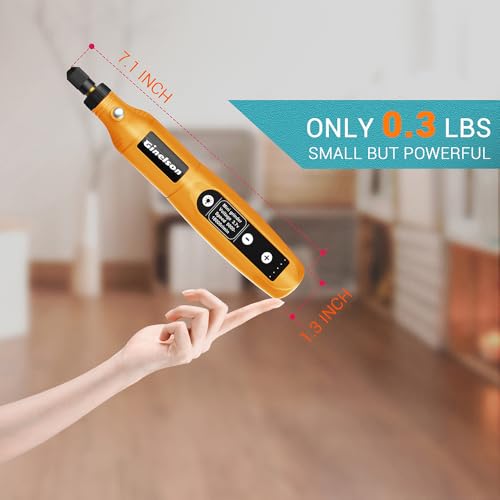
| Weight | 4.8 oz (approx.) |
| Dimensions | 17.3 x 3.3 x 3 cm |
| Included accessories | 70 assorted bits and attachments |
| Typical uses | Sanding, polishing, engraving, drilling, etching, cutting (light) |
What’s in the kit
Performance and real-world use
The tool shines in precision work: jewelry repair, model making, guitar restoration, small woodworking details, and light deburring. The narrow cylindrical body and low vibration let the user keep a steady hand for engraving and etching. The five-speed settings make it easy to start slow for delicate tasks and step up for faster sanding or polishing.
In practice, the motor is quiet compared to larger mains-powered rotary tools. The LED lighting is positioned to reduce shadowing near the bit, which helps when working on small surfaces. Battery life is a strong suit for the size: running times approach the advertised 240 minutes under light to moderate loads, but runtime will drop if the tool is used on demanding materials.
Power limitations become clear if the user attempts heavy cuts, thick metal grinding, or prolonged pressure against hardened surfaces. The unit is calibrated for finesse rather than brute force; forcing it into heavy work causes speed sag and can stress some of the lighter accessories.
Accessories breakdown and suitability
Tips for best results
Maintenance and care
Who this tool is best for
It is not recommended as a substitute for a heavy-duty rotary or angle grinder when tackling rusted bolts, thick metal removal, or industrial tasks.
Final thoughts
The Mini Cordless Rotary Tool offers an impressive balance of portability, run time, and control for its price. It excels where precision and convenience matter more than raw power. For users who prioritize a light tool for close-up work and occasional home projects, it represents a practical, easy-to-charge option. Those who need sustained torque and industrial-grade durability should consider a larger mains-powered alternative.
FAQ
It can cut thin, non-hardened metals such as thin sheet aluminum or soft brass when fitted with the correct metal cutting disc. The tool’s low torque and small motor make it unsuitable for thick or hardened steel.
For thick, hardened, or long metal cuts, they should choose a higher-torque mains-powered rotary or an angle grinder for safety and efficiency.
Runtime varies with task intensity, speed setting, and battery condition. The advertised ~240 minutes is achievable during light, intermittent hobby tasks like polishing or light sanding.
They should keep a charging plan: recharge between sessions, avoid fully depleting the battery regularly, and consider a spare battery or shorter work sessions for longer projects.
Many included bits follow common hobby rotary dimensions and will fit other small rotary tools, but compatibility depends on the tool’s collet (shaft) size.
They should tighten the collet correctly and avoid forcing larger shanks into a smaller collet.
USB-C offers a reversible, more robust connector and commonly supports higher charging currents than micro-USB. This makes plugging in easier and can lead to steadier charging when paired with a proper charger.
The tool likely includes basic battery protection, but good charging habits and quality accessories improve safety and battery life.
Beginners should start slowly and practice on scrap material. The compact size helps with precision, but technique matters more than force.
They will gain control and speed selection sense after a few practice sessions. Regularly check and replace worn bits for consistent results.
A few targeted extras make the kit much more versatile and durable.
These additions improve finish quality, extend the life of accessories, and make repeated, accurate work easier.

Little rant: instructions were tiny and a bit unclear. Took me a minute to figure out the speed dial and the on/off — felt like a puzzle. Otherwise, great for shaping polymer clay and light sanding. 🙂
Haha yes the tiny manual. I almost used it to start a campfire 😂
Pro tip: long-press is sometimes needed for safety lock on small tools, check that if it’s not turning on.
Sorry about the manuals — we’ll pass that feedback along. Glad it worked well with polymer clay though!
Question for people who’ve used it on metal: can this handle light drilling into thin sheet metal or is it only for wood/plastic?
Good question, Sarah. The tool can handle very light metal work like etching or small pilot holes in thin metal, but it’s not designed for sustained drilling into thicker metals.
You can drill thin sheet metal but go slow and expect low feed rate. Don’t force it — low torque means it stalls if you push too hard.
For anyone wondering about build quality: it’s mostly plastic but feels solid enough for hobby use. Don’t drop it though — I tested that (oops) and it survived but the plastic scuffed.
Thanks for the real-world test, Robert. The lightweight build is part of the design for portability, but it’s not indestructible.
Scuffs are part of the character! 😂 As long as it still works.
I dropped mine and the USB port bent a little — still works but just a heads-up to be careful.
Maybe get a little case or pouch if you carry it around.
Picked this up for small jewelry repairs and it’s surprisingly precise. The LED helps when I’m working inside tiny bezels. Battery lasts a few sessions for me, but I wouldn’t expect to sand down a whole project with it.
Pros: light, USB charging, lots of bits.
Cons: low torque for dense materials.
How long do your sessions last? Curious because the listing says ‘long battery life’ but that’s vague.
Totally — I used it for a resin pendant and it was perfect. If you need more power, look for a corded dremel-style for heavy stuff.
Glad it worked well for your jewelry work, Emma — that’s exactly the kind of delicate job this mini tool was built for. The tradeoff for size is torque, as you mentioned.
Bought this as a backup for my workshop. For the price (18.98 GBP) it’s a steal. Don’t expect it to replace my main rotary tool, but it’s great for quick touch-ups and etching on wood. Accessories are decent — a lot of them are small but useful.
Also: orange color looks exactly like the pics 😂
I cracked one of the sanding drums on first use 😅 Might’ve been operator error though.
Yep the price is tempting. Did you find any accessories that didn’t fit or were low quality?
If you’re doing a lot of cutting or grinding, those small bits do wear quickly. But for light use they’re fine.
Thanks for the feedback, Mark. The kit’s 70 accessories cover many small tasks, but a few might wear out faster depending on use. Good to have spares on hand.
I use this for small model-making tasks. Quiet, lightweight, and the speed control is surprisingly smooth.
One thing: the rpm range (5000–18000) is pretty broad — start slow for delicate plastics, ramp up for metal bits. Also, some bits heat up quickly so take breaks.
Yep. I set a timer for 5 minutes so I remember to rest the tool between sessions.
Great tips, Hannah. Heat buildup is common with small bits; short bursts of work help prolong both the bits and the motor.
USB charging means you can plug into a power bank if you need more runtime on the go.
Does the battery show charge level anywhere? Or is it guesswork?
No battery indicator on mine — you kind of learn from how it performs. A pain, but manageable.
Anyone tried engraving glass with this? Thinking of personalizing tumblers but worried about slipping.
I did a couple of wine glasses — go slow, use a diamond tip, and clamp the glass so it doesn’t move. Practice on a scrap first!
Engraving glass is a common use. A diamond bit and steady hand (or a jig) are key. Keep speed moderate to avoid chipping.
This is my weekend tinkering tool now. Two things I noticed:
1) The USB charging is really convenient — charges from my phone charger.
2) The chuck/collet could be tighter; I had a little wobble with one of the bits.
All that said, for ~19 quid this is perfect for hobbyists. Would recommend if you need a portable option.
I think it’s the smaller standard for mini tools, around 2.35mm-ish. Not 100% sure though.
Thanks for the detailed notes, James. Wobble can sometimes come from a bit that’s not seated fully — make sure it’s pushed in and the collet tightened. If persistent, reach out and we can suggest replacement collets.
2.35mm sounds right. I bought a set of extra bits and they fit ok.
Good tip — I had wobble too and just reseated the bit. Fixed it right away.
Do you know what size the collet is? Need to buy some bits separately.
Short and honest: great value for the price. If you want a pocket-sized precision tool for light DIY and crafts, buy it. If you plan to rip through hardwood or heavy metal, don’t. 😂
Also: manual typo on the product — it says ‘Easy to used’ which made me chuckle.
That typo is adorable. Makes the tool feel homemade 😂
Appreciate the straight talk, Luke — and the laugh about the manual typo. We’ll note that for future copy edits.
Love the compact size. Fits in my craft bag easily. Took it on a weekend trip and used it to refresh an old picture frame — quick and handy.
One tiny gripe: the LED is a bit cold/blue which messes with color matching when painting small details. Otherwise, very useful.
Or just take frequent breaks and look under natural light 😅
You can use a daylight lamp beside it for better color accuracy.
Interesting — never thought about LED color affecting painting. Makes sense though.
Good observation about the LED, Maria. That cool tint can shift color perception; some users prefer an external warm light for color-sensitive work.